
Written by: Centre for Men's Health

Reviewed for medical accuracy by Dr Ed Rainbow, BMBS, MRCGP, MSc, men’s health expert
Low testosterone, low T, male menopause, manopause, andropause, late onset hypogonadism and testosterone deficiency syndrome are just some of the names given to the condition that can wreck many men’s health and love lives. There are a range of low testosterone symptoms and signs, some of them serious. So what is low testosterone, what causes it and could you be suffering from it too?
What is testosterone?
First of all, let’s start with the basics: what is testosterone? In short, it is the hormone – the body’s chemical messenger – responsible for normal sexual development and function in men, the most important of a group of hormones called androgens. However, its role in men’s bodies is wider ranging than that. The level and effectiveness of testosterone can have an impact on many aspects of men’s health, from their ability to get erections and enjoy sex to the strength of their bones and the functioning of the brain.
Testosterone drives almost every aspect of male health and vitality, influencing energy levels, mood stability, cognitive function, muscle mass, bone density, metabolic health, and cardiovascular function.¹
What is low testosterone?
A man suffers from low testosterone levels when the hormone is either not present in the blood in sufficient quantities or not enough is available for use by the body’s tissues. Most of your testosterone is bound to proteins in your blood, including sex hormone binding globulin and albumin, and only 2-5% circulates as free testosterone – the active form your body can actually use. This is why measuring both total and free testosterone is essential – total testosterone alone doesn’t tell the complete story.²
Dr Ed says: the petrol analogy
Think of testosterone like the petrol in your car. Your body is the engine, and testosterone is the fuel that makes everything run smoothly. Sex hormone binding globulin (SHBG) is like the petrol tank – it stores the fuel safely. But here’s the thing: petrol in the tank doesn’t power your car. You need fuel in the engine. Free testosterone is the petrol that’s actually in the engine, available to power your body right now. Total testosterone is the petrol in the tank plus what’s in the engine. If your tank is full but nothing’s getting to the engine (high SHBG, low free testosterone), your car won’t run properly, even though the gauge says you have plenty of fuel.
What causes low testosterone?
As the Centre for Men’s Health’s founder, the late Professor Malcolm Carruthers, explained in his book Testosterone Resistance, low testosterone levels and activity can be caused in many different ways. The causes fall into several broad categories:
Age-related decline in testosterone
Testosterone naturally decreases by approximately 1-2% per year after age 30-40, though the rate varies significantly between individuals.³
Lifestyle factors causing low testosterone
- Heavy drinking
- Obesity
- Poor sleep quality
- Untreated obstructive sleep apnoea (OSA)
- Chronic stress
- Lack of physical activity
- Smoking
All of these can suppress testosterone production.⁴
Medical conditions associated with lower testosterone levels⁵
- Type 2 diabetes
- Metabolic syndrome
- Chronic kidney disease
- Liver disease
- HIV/AIDS
- Chronic inflammatory conditions
- Mumps
- Trauma to the testes
Medications and Low Testosterone
There are several medications used regularly by middle-aged men which can potentially lower testosterone levels, including:
- Statins (cholesterol-lowering drugs) – some evidence suggests modest testosterone reduction
- Antidepressants (particularly SSRIs) – can affect sexual function and may influence testosterone
- Blood pressure medications (especially beta-blockers and spironolactone) – some types more than others
- Opioid painkillers (including prescription pain medications) – can significantly suppress testosterone, sometimes causing “opioid-induced hypogonadism”
- Antiepileptic drugs (certain seizure medications)
- Antipsychotic medications (especially those affecting prolactin levels)
- Corticosteroids (long-term use)
- Finasteride (Post-Finasteride Syndrome – PFS)
Dr Ed says: detective work in the clinic
When I see patients in my clinic, I’m acting like a detective to work out if they have low testosterone, and more importantly, why. If we can identify the culprits, we can often do something about them.
Common simple approaches that can make a real difference include improving your diet (reducing processed foods, increasing protein and healthy fats), exercising more regularly (especially resistance training), stopping smoking or vaping, cutting back on alcohol, learning to relax and manage stress (whether that’s meditation, hobbies, or simply making time for yourself), treating sleep apnoea if present, and addressing obesity through sustainable lifestyle changes.
For many men, these lifestyle changes alone can significantly improve testosterone levels and symptoms. Medication is not always the answer – sometimes it’s about getting back to basics.
How is testosterone deficiency diagnosed?
All this means that your total testosterone level on its own, while important to test and monitor before and during any treatment, can’t tell you whether you are suffering from low testosterone or not. In order to reach a diagnosis of low testosterone or testosterone deficiency syndrome you will need a full blood test covering a wide spectrum of measures to reach a complete understanding of your hormonal health.
According to the 2023 British Society for Sexual Medicine (BSSM) guidelines, diagnosis requires both biochemical evidence (consistently low testosterone levels on repeat morning testing) and symptoms consistent with testosterone deficiency. The guidelines emphasise that testosterone testing should be performed in the morning (ideally before 11am) when levels are highest, and abnormal results should be repeated to confirm the diagnosis before considering treatment.⁶
Your doctor should also take a complete medical history and undertake a physical examination, in addition to a detailed discussion of your symptoms. This is to exclude the possibility that your symptoms might be related to other health problems.
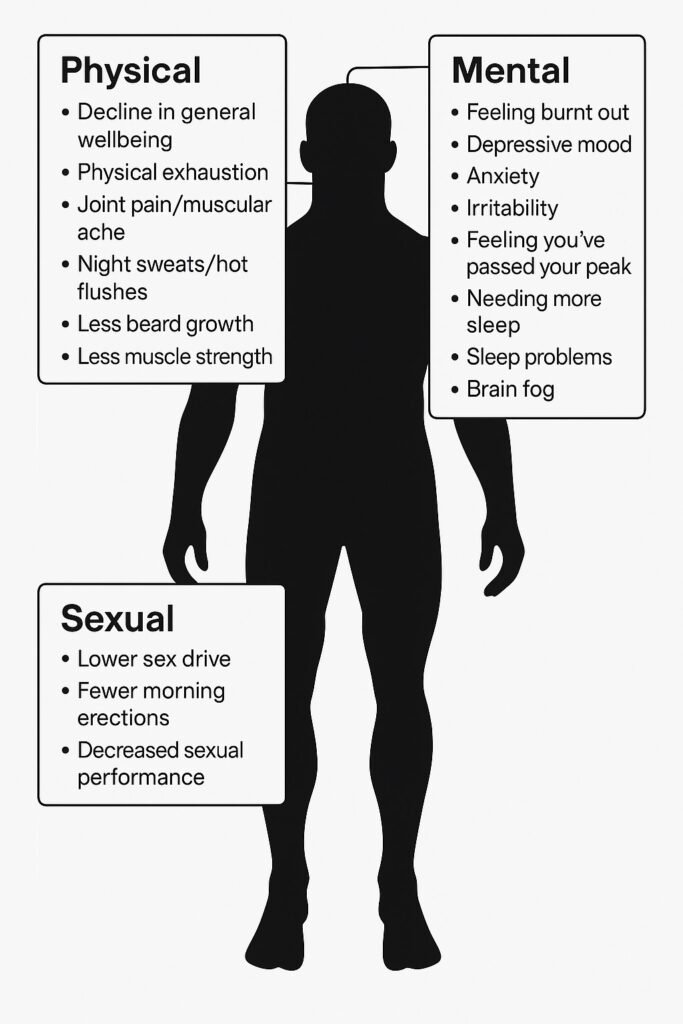
17 Signs of low testosterone
Low testosterone can show itself in a number of different ways. Low Testosterone symptoms include:
Physical low testosterone symptoms
- Decline in feeling of general wellbeing and health;
- Physical exhaustion and lack of vitality;
- Joint pain and muscular ache, including general back ache or lower back pain;
- Excessive sweating/night sweats and hot flushes;
- Decrease in beard growth;
- Decrease in muscular strength;
Sexual low testosterone symptoms
- Decrease in libido/sexual desire
- Decrease in the number of morning erections;
- Decrease in the ability to perform sexually/frequency of sex;
Mental/emotional low testosterone symptoms
- Feeling burnt out and having reached rock bottom;
- Feeling that you have passed your peak;
- Depressive mood or mood swings and lack of drive;
- Anxiety/Nervousness;
- Irritability/anger;
- Increased need for sleep/often feeling tired;
- Sleep problems including difficulty in falling asleep, difficulty in sleeping through, waking up early.
- Brain fog or confusion;
This list of symptoms comes from the internationally-recognised Aging Male Symptoms (AMS) ratings scale.1 Of these, fatigue, depression, irritability, reduced sex drive and erection problems are the most common. However, not everybody with the condition will have all of these symptoms and the severity of each will vary from person to person. It is also important to note that some of these, for instance fatigue, depression or anxiety may be non-specific to low T and maybe due to lifestyle factors.2 So it’s important that any diagnosis should be backed up by a comprehensive blood test, such as the one provided by the Centre for Men’s Health, that will also take into account other potential causes of these symptoms.
What are the wider health effects of low T?
Research has shown that low or ineffective testosterone levels are also implicated in many of the severe, long term illnesses which become common in men with ageing. Metabolic syndrome and diabetes, Alzheimer’s disease, coronary heart disease and angina, and erectile dysfunction are illnesses where it has been shown testosterone deficiency can be interrelated.
Low testosterone is strongly associated with central obesity, metabolic syndrome, and type 2 diabetes.⁷ Recent landmark trials like the TRAVERSE study (2023) involving over 5,200 men have demonstrated that testosterone replacement therapy, when properly monitored, does not increase cardiovascular risk – in fact, it improved sexual function, physical function, and quality of life without increasing major adverse cardiovascular events.⁸
What treatments are available for low testosterone?
The good news is that low testosterone in men can be successfully treated with testosterone replacement therapy (TRT), involving supplementing or stimulating the testosterone that a man’s body is already producing. There are a range of treatments to correct your low T levels that can be tailored to your needs and lifestyle, ranging from gels to testosterone injections. You can find out more about your low T therapy and treatment options here.
At Centre for Men’s Health, we follow the 2023 BSSM guidelines, as well as expert opinion from the Lisbon Protocol9 which emphasise confirming biochemical hypogonadism, ensuring symptoms are consistent with testosterone deficiency, comprehensive baseline assessment including prostate health, regular monitoring of symptoms, testosterone levels, haematocrit, PSA, and overall health, and addressing lifestyle factors (weight, exercise, sleep, alcohol) as first-line therapy.⁷
Conclusion
Modern evidence from landmark trials like TRAVERSE8 and the T-Trials10 demonstrates that testosterone replacement therapy, when appropriately prescribed and monitored, is both safe and effective for improving quality of life, sexual function, physical function, mood, and metabolic health in men with genuine testosterone deficiency.
If you find you are suffering from a number of these low testosterone symptoms at the same time, it is important to have your testosterone levels checked (both total and free testosterone) to understand the underlying cause and to see whether you could benefit from testosterone replacement therapy.
Last updated: 16 February 2026
References:
- Heinemann, L.A., Saad, F., Zimmermann, T. et al. The Aging Males’ Symptoms (AMS) scale: Update and compilation of international versions. Health Qual Life Outcomes 1, 15 (2003). https://doi.org/10.1186/1477-7525-1-15
- NHS, The Male Menopause (2022) https://www.nhs.uk/conditions/male-menopause
- Huhtaniemi IT. Late-onset hypogonadism: current concepts and controversies of pathogenesis, diagnosis and treatment. Asian J Androl. 2014;16(2):192-202. doi:10.4103/1008-682X.122336
- Sansone A, Sansone M, Selleri V, et al. The association between lifestyle factors and testosterone levels: A systematic review and meta-analysis. Endocrinology. 2023;164(10):bqad123.
- Corona G, Rastrelli G, Monami M, et al. Hypogonadism as a risk factor for cardiovascular mortality in men: a meta-analytical study. Eur J Endocrinol. 2011;165(5):687-701.
- Hackett G, Kirby M, Wylie K, et al. British Society for Sexual Medicine guidelines on the management of erectile dysfunction in men – 2023 update. J Sex Med. 2023. BSSM Practical Guide to Assessment and Management of Testosterone Deficiency. https://bssm.org.uk/wp-content/uploads/2023/02/BSSM-Practical-Guide-High-Res-single-pp-view-final.pdf
- Corona G, Giagulli VA, Maseroli E, et al. Therapy of endocrine disease: Testosterone supplementation and body composition: results from a meta-analysis study. Eur J Endocrinol. 2016;174(3):R99-116. https://pubmed.ncbi.nlm.nih.gov/26537862/
- Lincoff AM, Bhasin S, Flevaris P, et al. Cardiovascular Safety of Testosterone-Replacement Therapy. N Engl J Med. 2023;389(2):107-117. doi:10.1056/NEJMoa2215025 https://www.nejm.org/doi/full/10.1056/NEJMoa2215025
- Morgentaler A, Traish A, Hackett G, et al. (2019). Diagnosis and Treatment of Testosterone Deficiency: Updated Recommendations From the Lisbon 2018 International Consultation for Sexual Medicine. Sexual Medicine Reviews. 7(4):636-649. PMID: 31351915. https://pubmed.ncbi.nlm.nih.gov/31351915/
- Snyder PJ, Bhasin S, Cunningham GR, et al. Effects of Testosterone Treatment in Older Men. N Engl J Med. 2016;374(7):611-624. doi:10.1056/NEJMoa1506119 https://www.nejm.org/doi/full/10.1056/NEJMoa1506119